
We need to talk about descriptions.
Specifically, we need to talk about how we describe skin, and the subtle, often unintentional ways that language can reinforce harmful stereotypes, even in our favourite romance novels.
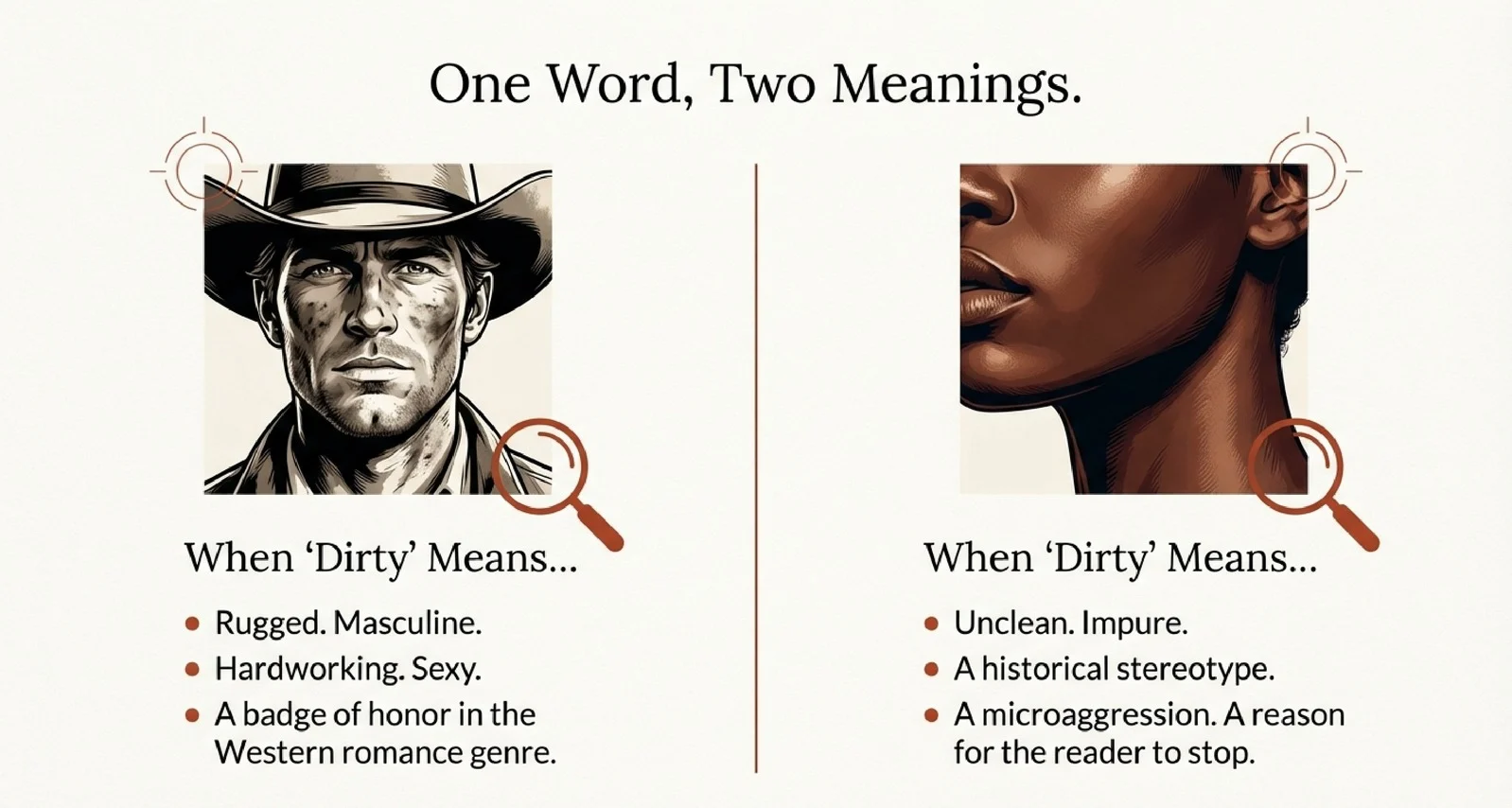
Recently, a specific line in a book by Elsie Silver sparked a necessary conversation in the bookish community. The description in question involves a young, white character with blond hair, described as having “a tan so dark that his knees almost appear dirty.”
On the surface, this might seem like a harmless way to describe a rugged, outdoorsy kid. But if we peel back the layers, this sentence exposes a deep-seated literary habit that equates darkness with uncleanliness.
Let’s unpack why this matters, why it hurts, and how we can do better.
The Burden of Historical Stereotypes
Language does not exist in a vacuum; it carries the weight of history.
- The Colonial Gaze: Historically, colonial literature and racist propaganda frequently associated dark skin with impurity, hygiene deficits, or moral corruption (“dirty”).
- The Reader Experience: For a reader from a marginalized community, encountering a tanned skin described as “dirty” creates an immediate dissonance. It stops the reading experience. Instead of seeing a “sexy cowboy,” the reader is forced to confront a racial microaggression.
- Reinforcement of Bias: Even if unintentional, pairing “tan” and “dirty” reinforces a subconscious societal bias that equates whiteness with purity and darkness with degradation. When a narrative celebrates the “grit” of a white character but uses the same terminology to describe the appearance of a “blackness”, it risks validating these harmful associations.
Evaluating Authorial Intention vs. Narrative Execution
First, let’s look at the author’s likely intention. Elsie Silver was almost certainly trying to paint a picture of a “feral,” free-roaming childhood. We’ve all seen those kids—sun-bleached hair, scabby knees, running wild in the summer sun. The goal was to evoke a sense of ruggedness.
However, in literature, impact always outweighs intent.
The phrasing didn’t say his knees were dirty because of mud or grass stains. It said they looked dirty because the tan was dark. The sentence structure creates a direct causal link:
Why This is Harmful (Even if the Character is White)
A common defence for lines like this is, “But the character is white! It can’t be racist.”
This is what critics call the “White Shield” Fallacy. While the character himself is not a person of colour, the imagery being used is rooted in anti-Black and anti-brown sentiment.
- Reinforcing Colourism: For centuries, colonial standards of beauty have dictated that whiteness is “pure” and “clean,” while brownness is “stained” or “dirty.” When a book suggests that a deep tan looks like grime, it validates that worldview.
- The Reader Experience: Imagine being a reader with naturally dark knees or elbows (a common biological trait for many people of colour due to hyperpigmentation). Reading that a dark skin tone “looks dirty” isn’t just a description of a fictional white boy; it reads as a judgment on your own body. It suggests that your natural skin needs to be washed off.
The Trust Gap
When an author, and by extension, their editorial team, lets a line like this slip through, it erodes trust.
For marginalized readers, reading a book like this is often an exercise in guarding oneself. You read waiting for the other shoe to drop, waiting for the text to remind you that you don’t belong in this fantasy. When a line conflates pigment with filth, it confirms that fear. It pulls the reader out of the romance and reminds them of the biases they face in the real world.
It also raises a question about the publishing process: Where were the sensitivity readers? Why did no one in the editing room pause at the equation of “dark” and “dirty”?
The “Loaded Words” Sensitivity Checklist
This isn’t about “cancelling” an author; it’s about asking for more nuance.
We can write vivid, rugged, and messy characters without relying on lazy, harmful tropes.
Here is a simple guide for writers (and a checklist for readers):
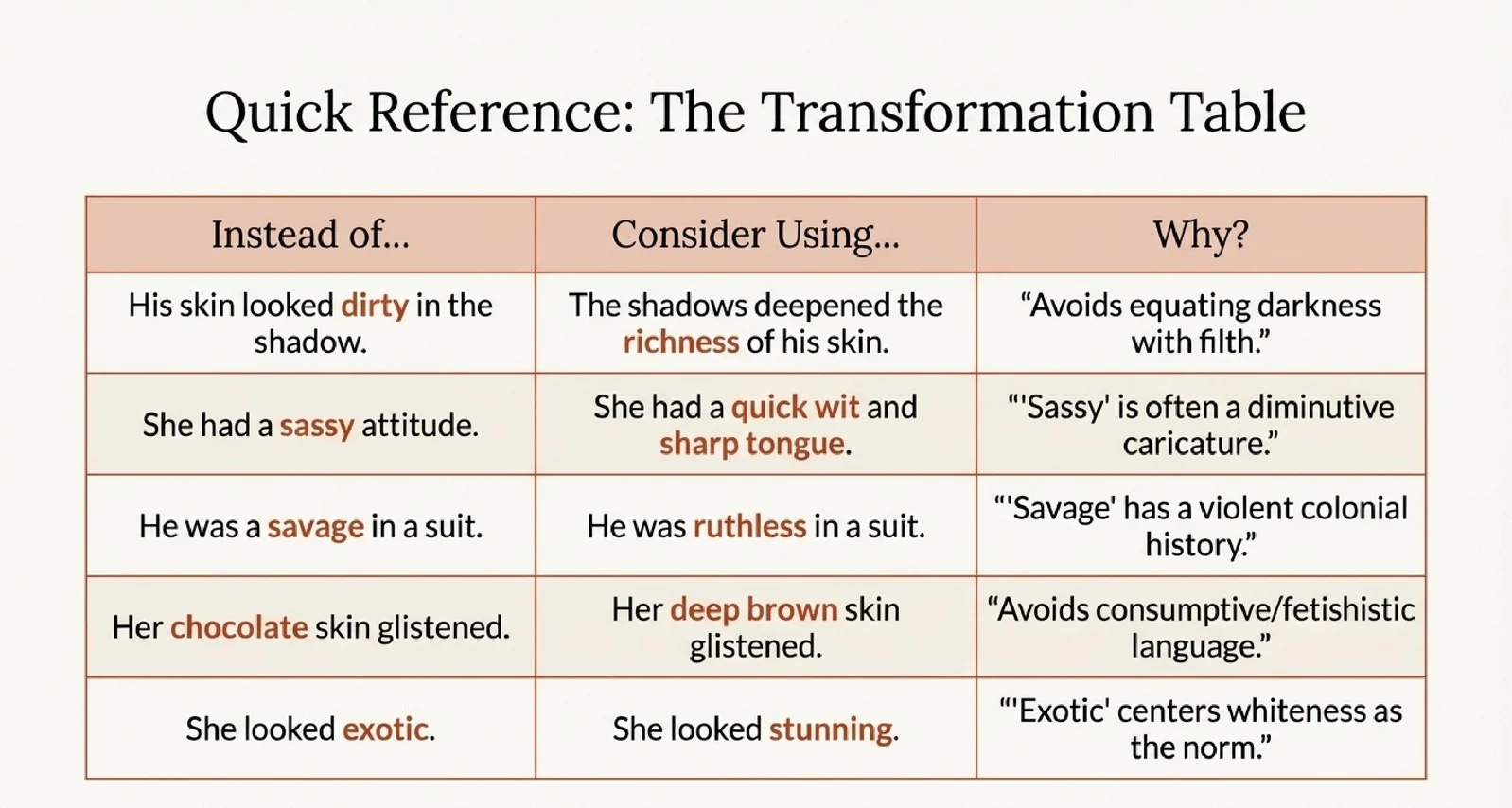
- Separate Pigment from Grime: If a character is dirty, describe the mud, the dust, the oil, or the grass stains.
- Describe Colour as Colour: If a character is tanned, use words that describe the shade—bronze, golden, deep umber, copper.
- Check Your Similes: Ask yourself, “Does this comparison rely on a stereotype?” If you are comparing a skin tone to dirt, soil, or food in a way that creates a value judgment, delete it.
Broader Implications for Credibility and Reception
Words shape our reality. They have the power to validate us or alienate us. By decoupling darkness from dirtiness, we make room for a literary world where brown skin is described with the same beauty and neutrality as white skin.
We can love a book and still demand it does better.
Let’s keep pushing for that nuance.